Hadest Serif Font for Handmade Labels & Printables
If you've ever spent hours tweaking a candle label, reworking an invitation layout, or second-guessing whether your boutique tag reads clearly at 3/8", you know how much weight the right serif font carries—not just in design, but in how customers *feel* about your product. That’s why Hadest has become my go-to display font for physical and digital craft projects that need presence, polish, and quiet confidence.
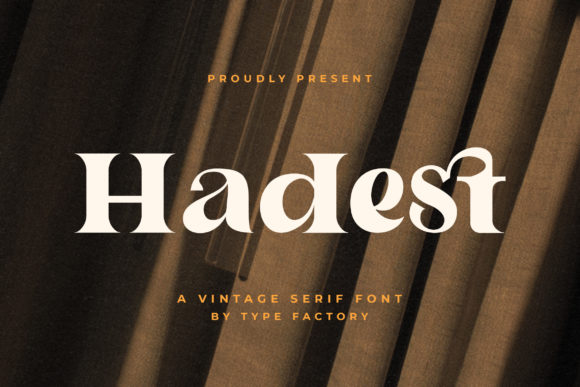
Hadest is a vintage-inspired serif—bold without shouting, stylish without sacrificing clarity. Its high-contrast strokes, subtle bracketed serifs, and generous x-height give it warmth and authority all at once. It doesn’t look like a museum relic; it looks like something you’d find on a hand-stamped apothecary jar or embossed on a linen wedding suite. That balance makes it unusually versatile: equally at home on a rustic farmhouse sign and a minimalist planner cover.
I use Hadest most often for short, high-impact text—product names, collection headers, welcome boards, and decorative phrases. Think “Small Batch,” “Hand-Poured,” “Est. 2021,” or “You’re Invited.” Its strong letterforms hold up beautifully when scaled down to 12–16pt on printed labels or cut cleanly on Cricut and Silhouette machines—even at 0.25" height on tiny sticker dots. For larger applications like wall art or framed printables, I love pairing it with a soft script or airy sans serif to create visual rhythm without competing.
Here’s where Hadest shines in real-world handmade work:
- Candle & soap labels: Its vintage character reinforces artisanal credibility—especially when paired with natural kraft paper or matte black stock. I’ve tested it at 10pt on 1.5" wide labels, and every letter cuts crisply.
- Wedding stationery: From “Mr. & Mrs.” on foil-stamped menus to “Welcome” on acrylic signage, Hadest adds timeless elegance without looking stiff or dated.
- Digital printables: Planner headers, habit trackers, and quote pages gain instant sophistication. Because it’s PUA encoded, I can access stylistic alternates and ligatures directly in Canva, Affinity Designer, or Silhouette Studio—no manual glyph hunting.
- SVG designs & merchandise: I’ve layered Hadest over distressed textures for t-shirt graphics and used its bold caps for tote bag lettering. The clean vector outlines mean no pixelation, even when resized for large-format prints.
- Seasonal packaging: For holiday mugs or gift tags, its sturdy serifs read well against busy patterns—unlike delicate scripts that get lost in the noise.
Readability matters—not just for eyes, but for machines and materials. Hadest avoids overly tight spacing and exaggerated swashes, so it performs reliably on thermal printers, inkjet labels, and vinyl cutters. I’ve used it for 6mm-wide iron-on transfers (with slight letter-spacing adjustment) and had zero issues with misalignment or clipping. For small stickers under 1", I stick to uppercase-only phrases—its capitals are especially balanced and legible.
Font pairing is where Hadest truly flexes its craft-friendly personality. As a display serif font, it pairs best with contrast—not clutter. My top combos:
- A relaxed handwritten or brush script for names or accents (e.g., “Eleanor” in a flowing script above “Hadest” for a bridal suite).
- A neutral, low-contrast sans serif like Montserrat or Lato for body text, ingredient lists, or care instructions—keeping hierarchy clear and professional.
- A complementary serif with lighter weight and more open spacing (like Playfair Display Light) if building multi-tiered typography for packaging or social media banners.
One practical note: Hadest includes standard OpenType features—ligatures, stylistic alternates, and extended Latin support—so it handles common European characters well. That’s helped me expand my Etsy listings into UK and Canadian markets without redesigning tags or PDFs. It’s not a full multilingual typeface, but for English-first creators selling globally, it covers the essentials cleanly.
Licensing is non-negotiable when you sell physical products, templates, SVG files, or digital downloads—and Hadest comes with a commercial license that covers exactly those uses. Whether you're bundling it into a Canva template pack, embedding it in a printable planner, or cutting it for client-branded merchandise, you’re covered. Just remember: you can’t resell the font file itself, and web embedding requires separate licensing (not needed for static PNGs or PDFs).
What sets Hadest apart from other bold serif fonts isn’t just its vintage charm—it’s how thoughtfully it bridges aesthetics and function. It doesn’t ask you to choose between “pretty” and “practical.” You don’t sacrifice readability for style, or scalability for character. When your customer picks up a jar labeled in Hadest, they don’t just see text—they sense intention, care, and quiet confidence in your brand identity. And when you open your design software and type out “New Collection,” that first capital “N” feels like a promise: solid, memorable, and unmistakably yours.